Showing posts with label guest post. Show all posts

Thursday, December 19, 2013

@GemmaFiles @ChiZinePub #Giveaway #Guest_Post "What I Learned from Writing the Hexslinger Series" - Gemma Files

Welcome once again! Today I have a great guest post from Gemma Files, author of the Hexslinger trilogy. You can read my review of the omnibus here, and from that post you can follow links to my reviews of the individual books in the trilogy. 

Also, at the bottom of this post is a Rafflecopter form; one lucky winner will receive a copy of the Hexslinger Omnibus, which includes all three books from the series plus three short stories set in the Hexslinger universe! Be sure to sign up.

Now, here is Gemma Files!


WHAT I LEARNED FROM WRITING THE HEXSLINGER SERIES, by Gemma Files

It was April of 2009, and my friend Sandra Kasturi—co-founder of ChiZine Publications—asked me if I was finally working on a novel yet, after fifteen years of sometimes award-winning short fiction sales in the horror/dark fantasy genre. “Well,” I said, hesitantly, “as a matter of fact...” “Great! What's it about?” “Um—it's a Weird Western with black magic, Aztec gods, and a big gay romance in the middle.” “Send us what you've got, and write a synopsis for the rest!” I did, they liked it, and by a month after that, this project I'd begun as a way to distract myself from the fact that having lost my job had coincided with my son's diagnosis of Austism Spectrum Disorder was suddenly a professional promise I needed to deliver on: get 100,000 words' worth of manuscript to CZP by roughly October, so it could be turned into a genuine book by sometime the next year.
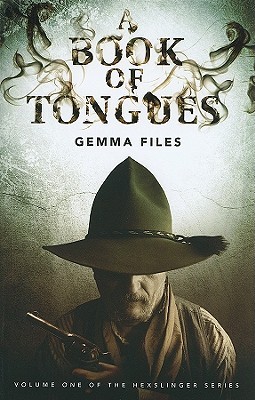
Fast-forward to 2013. That one novel—A Book of Tongues—is now three, making up the Hexslinger Series, and the series itself has been reformatted and released in an ebook-only Omnibus Edition (the perfect holiday gift for anybody who likes gunfights, spells, human sacrifice and hot M/M action, hint hint). Thus rolled back together, the story I once blithely thought would take 100,000 words to tell is actually more like 400,000 words-plus, with three all-new stories set in the Hexslinger-'verse slapped on the end, adding almost 30,000 more words to the mix. That's three years of my life, and a sharp shift in the trajectory of my career. I am a known quantity, now. I have fans and followers who are genuinely invested in whatever I do next, not to mention an ever-growing pool of people who recognize my name and may have formed opinions about my work without us having met, or even—on occasion—without them having read anything I've written. It's everything I ever wanted.


And it all happened, in part—fifteen previous years of hard work and professional contact-making aside—because while delivering on my initial promise to CZP, I failed to write one book so egregiously that I actually ended up writing three.

The way it consistently happened was this: I'd get to about the 80,000-word mark, look at my synopsis—the same synopsis I was following throughout, never deviating particularly from its original arc—and go: “Oh crap, there's no way I'm going to be done by 100,000 words.” By the end, Sandra dryly observed that “apparently, the Hexslinger series is a trilogy—and apparently, the only person who that's a surprise for is, strangely enough, Gemma.”

In hindsight, this structural strategy does indeed make a lot of sense, since the longest-form narratives I'd written up to that point were all screenplays; indeed, I'd made my living teaching screenwriting (as well as film history, and TV series development) for almost ten years, before my job suddenly disappeared. Even the fanfiction “novels” I'd written were all done episodically, as only befitted things mainly based on TV shows—and I'd still keep on severely underestimating what organically felt as though it should go where, in some cases ending up with “chapters” that had up to six sub-sections (5.1, 5.2., etc.). So to look back on the Hexslinger series afterwards and realize I'd organized the overall story into three rough “acts,” each taking up a book on its own, was extremely funny. I'd say I won't be doing that again, but frankly? I think I'd be lying.

In a lot of ways, everything I did, I did wrong. Very little pre-planning, and equally little world-building, for which I've been rightly criticized. The extent of my magic-system development was to come up with the rather neat idea that although in the Hexslinger-'verse some random people tend to suddenly bloom up into demigod-level natural magicians when put in life-threatening situations, the reason they haven't banded together and taken over the non-magical world is that they simply can't, because they're instinctually driven to parasite off each other's energy: any relationship between two hexes tends to end in mutually assured destruction via obsessive, addictive, often sexually-charged magic-vampirism. However, I then undercut this “mages don't meddle” truism by almost immediately asking, “Yeah, but what if...?,” and spent the rest of the series playing catch-up.

Essentially, I've discovered, my book-writing process is that I get the emotional beats first, then mess with what's around them—plot, character, theme, infrastructure—while already in transit, until what I know in my gut “should” happen actually can. It's possible that this is a very horror way to look at things, or perhaps a very short story way; it's certainly haphazard, which is a drawback. But the great thing about thinking, and revising, on your mental feet is that just as your characters' own experiences start to change their perspectives, you too will find yourself asking questions about what you've already put in place, and wanting to know more. This is never a bad thing.
For example: I entered A Book of Tongues knowing that I wanted to write a queer main character (proudly gay gunslinger Chess Pargeter) involved in a queer relationship, which is definitely not something that gets a lot of mainstream representation. But by the end of the novel, I was already slightly put off by how much the rest of my story had slanted back towards the default, possibly because even writing a revisionist Western involves playing with typical Western tropes—it was a very white book, a very male book, one in which the few female characters were almost all monsters, whores or whorish monsters, and while I was proud of having tried to screw with the traditional Western image of “Indians” by making Diné hex Grandma school the heck out of my antihero Reverend Rook, Chess's toxic love interest, that still left the two most villainous-appearing people/creatures in the story depicted as women of colour.

So I took up the challenge, and in the Hexslinger series's second installment—A Rope of Thorns—I not only deliberately tried to widen my scope in terms of character development by introducing people like Yancey Colder (a gifted young woman caught up in the fallout from Chess and the Rev's shenanigans, whose actions would turn out to drive much of the rest of the plot) and Yiska (Grandma's protegé, a two-spirited Diné warrior who lives like a man), but also going back and hopefully adding layers to various previously introduced characters (specifically Songbird, the albino Chinese hex mainly introduced to provide exposition and threat in Book, who also ends up in a very different place from where she started out).

Let me be clear—I'm not patting myself on the back, here, since I'm absolutely sure I didn't do any of this without the committing sort of failure that tends to appear whenever a person of privilege addresses intersectional issues while trying to tell an entertaining, well-paced story. But I'm glad for the opportunity, and now that I've done it on the fly once, it's entirely likely that I'll at least think these things over before I try again. This, too, is part of what I learned from writing the Hexslinger series.
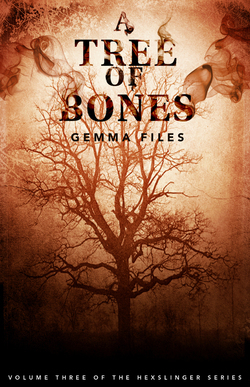
And finally, since I've probably gone on more than long enough—the most wonderful thing that this process taught me is that if I go exactly where I want to go, if I don't self-censor, if I don't tell myself “oh no, don't do that, it's self-indulgent and specious, and no one will ever want to come along for the ride”...sometimes, other people really will respond to it. I'll prove the mainstream, and myself, wrong in its/my assumptions. And in doing so, I'll create something that really does seem to have given far more readers than I ever expected a great deal of enjoyment.

These lessons were very much worth the entire journey, just as the result is very much worth the process, at least to me—but maybe to you too, if you give the Hexslinger Series Omnibus a chance. And best of all, you finally won't have to wait between installments.

Thank you, Gemma! Please feel free to comment if you have any questions or thoughts you want to share! 

Here is the giveaway, so good luck! Please note that there is not a PDF file available; you will need to indicate whether you prefer .epub (Nook) or .mobi (Kindle).

a Rafflecopter giveaway

Saturday, November 9, 2013

@JimGiammatteo Guest Post "How to Discover New Authors"


Murder Has Consequences

by Giacomo Giammatteo

on Tour October 1 - November 30, 2013

How To Discover New Authors
How do readers find new authors? In the old days of a few years ago most of it was done by browsing the bookstore. Most of us would start out in the aisles that housed our favorite genres but, at least for me, I’d end up wandering many aisles, including the bargain- and new-release shelves. I treasured those trips to the bookstores. My wife and I would make a weekend night out of it, and we seldom left the store before two hours were up. Usually, our arms were loaded with books when we went to the checkout counter.
The best part about the trips was the anticipation of discovering new authors. Finding someone I hadn’t read before and sitting down to read a sample to determine if I might enjoy the writing. I knew some of the people who worked at the store, and I usually asked them if they had read this book, or that author. Using this method I managed to be fairly accurate at picking out books I liked.
The problem now is I don’t go to the bookstore much anymore. All of my shopping is done online.
Pros and Cons
Shopping online for books is a lot more convenient. It’s a lot less expensive, too. And I don’t need to buy more bookshelves to hold the collection of hardbacks I have treasured for years. But it’s not all roses. Shopping online also has it’s downside. One of the biggest—for me—is that I miss the browsing.
Yes, I know you can browse online, and I know the selection is far, far bigger…but…I think that’s the problem. If you search Amazon’s mystery section in Kindle, there are more than 100,000 books. Just in mystery! How in the hell do you browse through 100,000 books?
Most people end up looking at the top sellers, usually a few dozen. Some go as far as checking out the top 100. Maybe they look at new releases or what’s hot. But at the end of a session, it’s doubtful if they saw more than 100 books. Highly doubtful if anyone sees 200. So how do those other authors get discovered?
It’s Tough

I can tell you, it’s not easy. I know because not only am I one of those other authors, I also am one of those readers looking through the list. About a year ago I stopped browsing my old way and started using the “average customer review” method. If you’re not familiar with how to do this, I’ll show you; it’s easy.
Go to Amazon’s site (B&N and Apple don’t have this method of sorting) and set the search bar for “Kindle books” and then type in what you’re looking for as far as genre goes. You can do a general search, like “mystery” or “romance” or “fantasy.” Or you can get very specific, “hard-boiled mystery,” or “crime fiction” or “epic fantasy.”
Once you get the results, look to the right and you’ll see a drop down menu that says “Sort” and by default it’s set to “relevance.” Click on it and select “average customer review.” The list will then change and you’ll be shown the top-ranked books in that category as rated by the reviews. This is not a strict order, but a ranking Amazon assigns based on a combination of number of reviews and review ranking.
It’s Not Foolproof
This is by no means a foolproof method. You can’t simply buy the top-ranked books and expect to be happy with your purchases, but it’s a damn good start to the process. This method doesn’t guarantee you’ll get a book you like, but it’s a fairly safe bet that the books near the top of these lists will be well-written, with few mistakes. If you combine this with reading a sample of the work, you should have good success in selecting books.
I found two great new authors this way—David Bishop and Christopher Bartley. Both of them write mysteries. Bartley’s series is set in Chicago in the 1930s and Bishop’s in the present day. I’ll be picking up more of both of their books. These are not authors I would have likely found anywhere else. They’re not typically hanging out with the “Top 100” crowd on Amazon or B&N, and they don’t have big advertising budgets from one of the traditional publishing houses, which means that discovery relies on other means.

If you haven’t tried this yet, give it a go, you might find some new good reads. And whatever you do, try to leave a review when you’re done. It helps us new authors be discovered. 

Author Bio:

Giacomo Giammatteo lives in Texas, where he and his wife run an animal sanctuary and take care of 41 loving rescues. By day, he works as a headhunter in the medical device industry, and at night, he writes.

Catch Up With the Author:


Wednesday, September 18, 2013

@BeccaJCampbell "Empath" blog tour, Guest post by Becca J. Campbell - Incubating the Psychopath


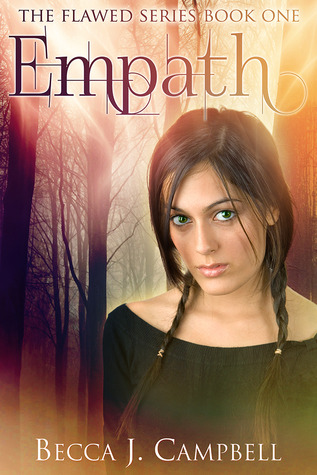
Today I'd like to welcome Becca J. Campbell back to Now is Gone. We're celebrating her new book Empath, my review of which is here, and she's written a fascinating guest post for us today. I'll also provide some basic info about the book and where to find it. First, let's hear from Becca!

Incubating the Psychopath: A Villain With a Thirst for Fear


Welcome to the Empath Blog Tour! During the tour, Empath (The Flawed Series Book One) is on sale for a discounted price of $0.99. Read on to find out more about the making of one chilling antagonist.

Entering the Mind of a Killer


Flawed is a series about individuals with superhuman weaknesses, one of whom is a psychopathic killer named Ethan Black. Like the others in the story with unique traits, Ethan's ability has an upside and a downside. I'm not going to spoil it here, so you'll have to read it to find out what those are. But the superhuman aspect wasn't the most difficult or the most interesting part of writing this villain.

Early into the writing of the story, I had some trepidation about what it would mean for me to enter the mind of a serial killer. Could I handle delving into that kind of darkness? Would it change me somehow? For a while I avoided writing Ethan's scenes. I knew they would come into play at the end of the story, but I wanted to stick with my non-psycho characters for as long as possible. I'm not sure why I was worried. When I finally dug into Ethan's character, he was a lot of fun to write, even with the dark brutality that makes think so little of capturing and killing women.

Suspense isn't my primary genre, but there was a time when I read quite a few thrillers. My biggest two influences are Dean Koontz and Ted Dekker. Both are experts at crafting killers. I learned from their work, though I can't name any specific traits I borrowed from either. From what I read, most psychopaths have quirks and obsessions, as well as the delusion of grandeur about themselves.

Ethan has his own odd qualities. The strongest of these is a fixation on instilling fear in his victims. He doesn't merely want to capture and kill them, he gets pleasure from finding what they are afraid of and using it to torment them. His obsession with fear is related to his screwed-up past, and his multi-phobic mother. Another of Ethan's quirks is his obsession with beauty, specifically young women with highly contrasting features. He seeks out women with pale skin and dark hair because he deems them more beautiful than others.

Like many psychopaths, Ethan knows how to blend in to society, how to be the perfect, suave gentleman, and how to portray humility and even weakness, when it serves his purpose. Another book I read that was a great example of this type of character was Devil in the White City, a true account of the serial killer during the 1890 Chicago World's Fair. It's fascinating to hear what that man got away with and how many people he fooled because of his acting skills and the naiveté of the general population.

Below is an excerpt from Ethan's point of view, giving you a peek into this killer's mind.

Excerpt


"Ethan clenched his eyes shut as he ran, and the two nasal voices echoed through his brain. Sometimes his heightened senses were a curse. By the changes in sound he could tell when one woman leaned forward to talk around him and when the other turned to the television, the reverberations of her words changing direction. If he focused hard enough, he could almost feel the sound waves vibrating through the air, tickling the hairs on his ears.

A strong, perfumed scent—not to his taste at all—came from the woman on the left, mixing with the mild odor of his own sweat. In an instant he could spin to the left and wring her neck. He could coil around to the other woman and knock her out, too. In under a minute. Thirty seconds, maybe. All without looking. It would be an intriguing challenge to see how fast he could do it.

But this wasn’t the place. Too many onlookers. Instead he forced aside the whining voices and tried to focus on his legs, pumping their hardest. His fingertips uncurled from the handlebar and traced their way up the control pad, registering the correct button by touch. He cranked the speed on the treadmill. His steps increased to keep up, producing a satisfying, padding sound as his cushioned sneakers met the rubber. He stretched his toes, feeling the texture of his cotton athletic socks. Warmth spread from his soles up through his thighs. He could feel the burn. It was good.

“I can’t even imagine,” the first woman continued. “I’m terrified of snakes.”

“What kind of psychopath would do such a thing?” the second asked.

After a few minutes of enduring their discussion on the alleged killer at large, Ethan leapt off the treadmill, grabbed his cane, and marched over to the free weights. He loaded up the barbell, tasting the salty sweat that clung to his upper lip. As he bench-pressed the heavy load, he reveled in his own strength. He was not a large man, but with time and dedication he had eradicated weakness in himself—a truly rewarding feat.

The corner of his lip curled as he remembered the events of the previous night. It had been a pleasant one. His companion had satisfied him with the perfect blend of beauty and fright. Both traits were attractive, the latter more than the former. But the physical aspect made his game more visually appealing. She’d been pale with dark hair and eyes. Gorgeous.

It was all about contrast. The play of a face so beautiful twisted into something almost grotesque—a dramatic transformation by fear alone. The visual dynamic of her smooth, pristine skin marred with dark blood from the puncture wounds. The lingering image in his mind made his pulse race more than the workout did."

Grab Empath at a Discounted Price


Empath is on sale during the blog tour for a bargain price of $0.99 (normally $2.99)! Grab your copy today:


Or purchase it on paperback.

Book Blurb

Supernatural empathy isn’t a gift, it’s a curse. Anywhere she goes, Jade’s emotions are replaced by those of the people around her.

Jade grew up in a suburb of Colorado Springs, protected from other people by her parents. Now she faces college—and the world—with nothing to shield her from unwanted feelings.

When Cam, a classmate with a major crush on her, unintentionally hijacks her emotions, Jade struggles to keep from being carried away in feelings of attraction. When Ethan, a psychopath with a thirst for fear, fixates on her, the emotional impact could be lethal.

Caught in a deadly trap, Jade must untangle the emotions and find a way to use her empathic curse to overcome this killer or be overcome by him.

More About Becca J. Campbell

Becca J. Campbell is the author of the New Adult Romantic Science Fiction novels Foreign Identity and Gateway to Reality, New Adult Romantic Paranormal Thriller Empath (The Flawed Series #1), and  Sub-Normal, a series of Science Fiction short stories.


An avid lover of stories that tiptoe the line between fantasy and reality (even when they plunge off one side or the other), Becca looks for new angles on bridging the gap between the two. She holds a special place in her heart for any story that involves superpowers or time travel. Her passion is defying the limits of her own creativity. You can find her on her Author 

Wednesday, September 11, 2013

@Rasnictem and @ChiZinePub: Steve Tem Guest post: The Genre Question featuring "Celestial Inventories"

Today I have a guest post from Steve Rasnic Tem, author of Celestial Inventories from ChiZine Pub.  Before I turn things over to Steve, let me give you the synopsis of this very interesting-sounding anthology. I have this book in my review queue, so I'll be reviewing it at some point as well.

Synopsis:
Among the transforming events in these twenty-two genre-bending stories: an office worker and his wife fade into a literal invisibility; a photographer discovers the unexpected in the faces of dead children; a girl moves onto a strange street when she fails to return from trick-or-treating; an artist devotes his career to contracting diseases; a plague of head explosions becomes a new form of terrorism; a couple's aging dismantles reality; and a seemingly pointless life finds final expression in bits of folded paper. Steve Rasnic Tem's other works include Deadfall Hotel, Onion Songs, Ugly Behavior, and The Man on the Ceiling. Celestial Inventories may be the World Fantasy Award-winning author's finest collection to date.

Doesn't that sound interesting? I've linked to its Amazon page above on the title, so go check it out if you're interested. Now, without further ado, is Steve Rasnic Tem to talk about "The Genre Question".

THE GENRE CONVERSATION
Steve Rasnic Tem

I’ve loved genre fiction almost as long as I’ve been reading.  Our high school library didn’t have much of it—I had to make do with Jules Verne, folklore, and fairy tales.  But my cousin had several crates of Gold Medal paperbacks stored at my grand parents’ house—noir fiction mostly—and I happily read through those over several summers.  And when our small community finally got a public library I read my way through every book with one of those “science fiction” stickers on it.  Then I tackled the mysteries, and the westerns.  It’s a love that has never left me, and when I first started writing, I wanted to write stories like the ones in those books.

Or did I?

What attracted me to science fiction and fantasy initially was that sense that it was about, essentially, an invisible world.  I couldn’t step outside my house and point to the things and environments which populated these stories.  These tales were furnished with things of the mind—objects which hadn’t yet been invented or perhaps only existed inside dreams or in the imagination.  And yet to me they felt so real.  They elicited a strong emotional response.  They seemed, for whatever reason, essential.  And these stories were the only way I could access them.

When you begin writing your first task is to learn how to write a story that “works,” that feels satisfactory and complete on the page.  You do this by studying stories and taking them apart, playing with the tropes in your favorite fiction and using them in new ways.  And once you’ve finally learned how to write a story that works you’re reluctant to depart from the methods and approaches you used to get there.

The only problem with this is that you’ve forced your imagination down a narrower and narrower path in order to get to those first stories that work for an editor and for an audience.  To a certain extent the results of your imaginative explorations have been preselected, your imagination “filtered.” This is a necessary process, especially in the beginning—there are simply too many choices to be made, and the structures of genre can simplify those selections.  The drawback, however, is that you’ve also had to cut yourself off from some of your originality.  At a certain point genre fiction becomes predictable fiction.

I’ve spent much of the last ten years trying to roll my process back a bit.  In a way, I’ve tried to unschool my imagination, to get it back to a beginning in which I knew less about what I was doing, but imagined more.  It’s a difficult process.  It’s hard to loosen your grip on that leash of what you know.  But I noticed that some of the stories that came out of that process were different somehow.  They looked like fantasy, sf, and horror stories, but they weren’t quite of those genres.  As close as I’ve come to define, these stories became participants in a conversation with f and sf.  What I liked about them most was that they seemed more “mine” than many of the stories I had written previously.

Writers often tell me, “I’m a horror writer because the only ideas that ever occur to me are horror ideas” or “I’m a science fiction writer because I only come up with science fiction ideas.”  But I believe that it’s too easy to program ourselves to create only within certain parameters.  The reason we come up with only horror ideas is that’s the only place we’re seriously looking.  So I encourage writers to force themselves to look in other places and come up with different kinds of ideas. 
Sometimes in order to break myself of the genre habit I play games with my imagination. I set up a framework for a story and then develop it depending on things that are entirely random.  My novelette “Celestial Inventory” takes place in one room.  A man has lived there his entire life.  I decided I was going to write the story from somewhere in middle age until the day of his death, and in order to structure it I wrote words on slips of paper, objects that would be in a room, and I decided, arbitrarily, that I had to write about those things in that order and consistent with his aging.  So I wrote about batteries, dust bunnies, coat hangers, doors, floor, ceiling, etc. Each piece became an imaginative meta-essay about that object (ala Francis Ponge). And it was the most fun I’d ever had writing. 

Later I wrote a novella for Wormhole Books—“The World Recalled” --in which I did the reverse.  The story starts with the day of the character’s death.  I gave him a strange kind of aphasia in which he says things incorrectly.  I put pieces of paper with words into a bag and drew two of them at a time, pulling up combinations like BED SLIDE and SHOWER RADIO and NEWSPAPER LADLE.  Each section of the novella was to have one of those phrases as its title.  So I had to write a piece about a newspaper ladle, taking place when he is somewhere in his thirties. 

“The World Recalled” is not really classifiable in terms of genre.  I suppose it’s something like magical realism, although I hesitate to use that term out of its cultural context.  I think it’s one of the best things I’ve ever written.  It stretched what I could do.  These two works, “The World Recalled” and “Celestial Inventory,” begin and end my new collection CELESTIAL INVENTORIES (ChiZine, August).

In his essay “The Trans-Realist Manifesto,” science fiction writer Rudy Rucker posits that the tropes of science fiction can be identified with basic modes of human communication and interaction.  Time travel corresponds with memory, flight with enlightenment, alternate worlds with the variety of human perspective, telepathy with our ability to communicate fully.  So he takes a basic human need and relates it to a science fiction trope. 

You can do the same thing with horror.  You might posit that ghost stories are really about the persistence of memory, vampires about spiritual and physical hunger, werewolves about anger and insatiable need.  I imagine you could even do something similar with mystery or western tropes.  What excites me most about this process is it’s a way to conceptualize stories at the level of basic human emotions before genre comes into play—potentially it’s a way to circumvent the damage that genre consciousness can do to your imaginative process.


CELESTIAL INVENTORIES collects many of the stories I wrote during my process of attempting to loosen the ties of genre.  I’ve also included a few earlier stories which seemed consistent with this approach. They don’t abandon genre entirely—in fact in some ways I think they express my love for genre.  Some of them veer further from the traditional expectations of f & sf than others, but all I think, feel very much “mine.”    

Feel free to comment with your thoughts about genre below. Remember, they're moderated, which means they won't show up right away, but I'll approve them just as quickly as I can. Thanks for joining me here today!

Sunday, September 1, 2013

@JKSLitPublicity Presents: Book Feature "Where They Bury You" and Guest Post by Steve W. Kohlhagen

ISBN: 978-0-86534-936-0
Hardcover, $32.95
Paperback, $24.95
eBook, $9.99
344 pages
September 2, 2013
Sunstone Press


In August 1863, during Kit Carson’s roundup of the Navajo, Santa Fe’s Marshal is found dead in an arroyo near what is now the Hubbel Trading Post. The murder, and the roughly million of today’s dollars in cash and belongings in his saddlebags, is historically factual. Carson’s actual explanation is implausible.

Who did kill Carson’s “brave and lamented” Major? The answer is revealed in this tale of a group of con artists operating in 1861-1863 in the New Mexico and Arizona Territories. As a matter of historical fact, millions of today’s dollars were embezzled from the Army, the Church, and the New Mexico Territory during this time. In this fictionalized version, the group includes a Santa Fe poker dealer with a checkered past claiming to fall in love with one of her co-conspirators, and the historically accurate duo of the Marshal of Santa Fe and the aide de camp of the Territories’ Commanding General. It is an epic tale of murder and mystery, of staggering thefts, of love and deceit.

Both a Western and a Civil War novel, this murder mystery occurs in and among Cochise’s Chiricahua Apache Wars, the Navajo depredations and wars, Indian Agent Kit Carson’s return from retirement, and the Civil War. The story follows the con artists, some historical, some fictional, during their poker games, scams, love affairs, and bank robberies, right into that arroyo deep in Navajo country.

ABOUT STEVEN W. KOHLHAGEN


Steve Kohlhagen is a former, now retired, Economics professor at the University of California, Berkeley, a retired Wall Street investment banker, and is on several corporate boards, most recently elected to the board of Freddie Mac. While at Berkeley he authored many economics publications, and he and his wife Gale jointly published the murder mystery “Tiger Found” under their pen name Steven Gale in 2008.

Kohlhagen was inspired to write his latest book “Where They Bury You” after reading Hampton Sides’ “Blood and Thunder,” a non-fiction history of Kit Carson and the West. Sides’ reporting of the factual murder of Marshal Joseph Cummings on August 18, 1863 led Kohlhagen to conduct further research on Carson and Cummings, including at the National Archives. He also pulled from his own knowledge of the West, as the writer divides his time between the New Mexico-Colorado border high in the San Juan Mountains and Charleston, South Carolina.
I have a guest post by Mr. Kohlhagen, so let me just put that right here.  He's going to talk to us a bit about how his careers at Wall Street and in academia worked out to put him onto a writing path.  So, here we go!

There is actually a common thread in my careers that most everybody misses.

When I was on Wall Street, people would I ask if I missed teaching and research at Berkeley. And I pointed out that creating and selling complex financial instruments involved a great deal of thoughtful research and successful teaching. Investment banking and derivatives is a constant swirl of researching, learning, and then developing new products. And then the process of training colleagues and then selling to both bosses and customers/clients is nothing more than teaching. And teaching at a very exciting level. None of the Wall Street “students” and clients are there because they are required to be there. All the “students” are interested and engaged. It’s teaching at an exhilarating level.

Then when I announced I was off to write murder mysteries, everybody said, “Huh?” Or words to that effect. “How does that follow writing academic papers and running a trading room floor?” And I responded that I’d always been writing. And that many had always viewed it as fiction. Go back and ask my students and they’ll tell you that my academic papers seemed like fiction to them. And my former Wall Street bosses and clients? What are sales documents but a story that pulls in the audience and convinces them of the reality of the underlying premise.

In short, all are always about communication. Writing academic papers, writing memos to sell a concept or a product, producing sales documents, giving oral or written sales pitches, discovering new theories or new empirical relationships, and then communicating each of these to an audience that needs to be convinced, are all about writing a good story. The major difference is that all of those activities have to create a convincing story in the real world, while writing effective fiction needs to create characters and stories at least as compelling, but that carry the audience into past, present, and future worlds that they care about hopefully, more than they do about memos and sales documents.

  How I got into writing murder mysteries specifically, also relates directly to my academic career. About 35 years ago, I told my wife and two mutual friends that I thought mysteries were a “waste of time.” My exact words. The guy, a colleague of mine at Berkeley, amusingly asked me what I did like in fiction. I told him “characterizations.” He smiled and returned with five books. Said, “read these and then see if you change your mind.” I did, and, well, I did. After that I became a voracious reader of Elmore Leonard, Ross Thomas, Robert Parker, et. al. Then decided when I retired from investment banking, I wanted to make the “natural transition”---for me, at least---into writing murder mysteries.


Interesting stuff, eh? I'm also a huge fan of the late Elmore Leonard and like the earlier Robert Parker books; those are good choices for starting on mysteries!  Finally, here's a press release to just tell you a bit more about this book. Enjoy!

FOR IMMEDIATE RELEASE                                                                                                                 CONTACT: Marissa Curnutte
347-574-3136

FROM WALL STREET TO THE WEST
Financial guru Steven W. Kohlhagen turns to his roots in the American West high desert for his first historical fiction novel ‘Where They Bury You’

SANTA FE, NEW MEXICO – Steve Kohlhagen wasn’t convinced after reading Hampton Sides’ nonfiction account, “Blood and Thunder,” that American frontiersman and Indian fighter Kit Carson’s official report of the events in August 1863 was entirely true. And in the 150th anniversary year, Kohlhagen begs the question, “Did the Navajos really shoot Carson’s Marshal?”

His new book “Where They Bury You” puts a different spin on what’s found in the history books. Based on actual facts and a very real murder, this Western murder mystery takes place during the Civil War battles in the New Mexico and Arizona Territories. A former Wall Street investment banker who currently sits on several Board of Directors, most recently joining Freddie Mac’s, Kohlhagen’s retired life in the San Juan Mountains gives him a unique perspective on the region about which he writes.

After researching a group of con artists who did, indeed, embezzle millions of today’s dollars, Kohlhagen sheds fictional light on who committed the actual August 18, 1863 murder of Santa Fe’s Provost Marshal deep in Navajo Territory. The novel vividly depicts battles among Cochise’s Chiricahua Apaches, the Navajo and other Southwestern Indian tribes, Kit Carson, the Union Army, volunteers from the western Territories, and the attacking Confederate Rebels from Texas.

“Steve Kohlhagen knows the West, knows his history, and combines them here into a fast-paced, irresistible story!” raves Bernard Cornwell, award-winning author of over 50 historical fiction novels who USA Today calls “the reigning king of historical fiction.”

“Where They Bury You” is a thrill ride into the old and mysterious ways of the West, to a place and time in history that provides surprises along the way.


###

Thursday, August 29, 2013

@ElizaTilton and @Curiosity Quills #GuestPost #Books Featuring "Broken Forest" by Eliza Tilton

Hopeless he'll never be more than the boy who didn't save his brother, 17-year-old Avikar accepts his life as the family stable boy, trying to forget the past. But when his sister, Jeslyn, is kidnapped, the thought of losing another sibling catapults him on a desperate quest. With his best friend by his side, and using the tracking skills he learned from his father, he discovers Jeslyn has been taken, kidnapped by one Lucino, the young lord of Daath, a mystical place thought only to exist in fables.

And Lucino has plans for Jeslyn.

His shape-shifting brethren feed off the auras of humans, and Jeslyn's golden hue is exactly what Lucino needs to increase his power. The longer it takes Avikar to reach her, the more entranced she becomes with Lucino's world, and     the harder it will be for Avikar to set her free.

He failed his family once. He won't fail again.

  
Broken Forest is told from three alternating perspectives: the hero, the kidnapped girl and the enchanting lord who may or may not be human. Writing in the three different POV’s allowed me to delve into each character. Most high fantasy tends to be written in 3rd person, but I love the closeness of first. Through each character’s chapters you get a different view on what their feeling and why they’re doing what they’re doing. Most readers don’t get to see the villain’s side, well, in Broken Forest you do.

This fantasy is a blend of adventure and romance. A fast paced read with tons of action that will keep you flipping to the next page.


Eliza Tilton is the author of the YA Fantasy, Broken Forest, published by Curiosity Quills Press. You can find her blogging about video games and writing on her blog and doing bi-weekly posts on author media over at YAStands.

She graduated from Dowling College with a BS in Visual Communications. When she’s not arguing with excel at her day job, or playing Dragon Age 2, again, she’s writing. Her stories hold a bit of the fantastical and there’s always a romance. She resides on Long Island with her husband, two kids and one very snuggly pit bull.

STALK THE AUTHOR: