Showing posts with label editing tips. Show all posts

Thursday, June 27, 2013

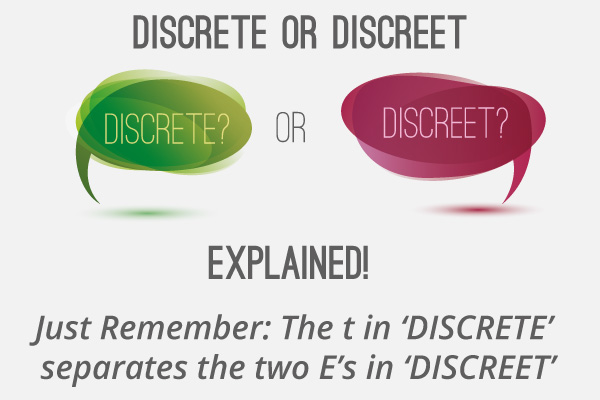
Discrete has nothing to do with Discretion...

So, time for another editing lesson!  This week: discrete vs. discreet!  I see this all over the place, and I can actually understand where the confusion comes from.  After all, "discretion" has only the one "e" there all by itself, so logic says it should be "discrete."

BZZZZZZT!!  WRONG!

Okay, so "discrete" means (according to the Merriam-Webster dictionary):

1
: constituting a separate entity : individually distinct <several discrete sections>
2
a : consisting of distinct or unconnected elements :noncontinuous
b : taking on or having a finite or countably infinite number of values <discrete probabilities> <a discrete random variable>
— dis·crete·ly adverb
— dis·crete·ness noun

Whereas "discreet" means:

1
: having or showing discernment or good judgment in conduct and especially in speech : prudentespecially : capable of preserving prudent silence
2
: unpretentiousmodest <the warmth and discreet elegance of a civilized home — Joseph Wechsberg>

I hope that helps!  Please be sure to review earlier editing tips We Gotta Get Out of This Habit and Department of Redundancy Department.


Saturday, April 27, 2013

Department of Redundancy Department: More Editing tips

So, as an editor I tend to notice a lot of things when I'm reading that just drive me crazy! You may remember my recent post We Gotta Get out of this Habit, addressing the distressing tendency so many people have to overuse the words "got" and "get". Well, along a similar vein, let's talk about redundancy. This happens far too often. Take this paragraph, for example:

Shannon stood to his feet and walked down the sidewalk to the street. Shrugging his shoulders, he looked both ways, turning his head, and then nodded his head up and down a few times, as though coming to some internal decision. The street stretched empty and uninhabited. He knelt to his knees, then rose to his feet, holding the weed he'd pulled from the crack in the sidewalk while shaking his head side to side to indicate no. The whole entire world seemed to hold its breath.

Do you see all the redundancies in that paragraph? I know I see them. Phrases like "stood to his feet" and "shrugging his shoulder" and "nodded his head up and down", multiple adjectives that mean the same thing. Let me show you the cleaned-up version of this same paragraph.

Shannon stood and followed the sidewalk to the street. Shrugging, he looked both ways and nodded, as though coming to some internal decision. The street stretched, desolate. He knelt then stood, holding the weed he'd pulled from the crack in the sidewalk while shaking his head. The entire world seemed to hold its breath.

The whole thing is sort of stupid, but I hope it made my point. Some other redundant phrases I've seen lately:
"sipping at a drink"
"wave her hand"
"rose to her knees" or "rose to her feet"

Anyway, I hope you understand what I mean.  The thing is, your story isn't just about word count.  I know a lot of people who are obsessed about word count, and that will cause them to pad out their story with unnecessary words and phrases.  Keep it clean.  That doesn't mean you need to be terse and staccato, but there is no need for some of the extras I've seen lately.

Until next time...

Wednesday, April 3, 2013

We Gotta Get Out of This Habit


So, today I'm switching gears a little and will actually be writing content! Yes, I know, it's incredible... Today, I want to talk to you about a grammatical laziness that is rife throughout society, and that's the use of the words “got” and “get”.

See, when I was in grade school, I had this really wonderful teacher for both grades 3 and 5 (she recently passed away from brain cancer. RIP Mrs. Johannes). I recall her telling us that the use of “got” and “get” is almost always unnecessary, superfluous, and/or lazy, and she told us a story about a professor that would literally take out a pair of scissors and excise every use of those words from student's papers. When I started editing, I didn't really pay attention to this at first, but in the past several months I have started to, and she was so right.

Take these sentences for instance:
I've got to get going.

You've got to be kidding.

They had to get home.

Fairly typical usage. However, think about what those sentences are doing, and take “got” and “get out, and see what happens.
I have to leave now.

You have to be kidding or alternately You must be joking.

They had to return home.

You see how much better that sounds? Do yourself a favor and start to be aware of your use of these words. Try to deliberately remove them from your speech and writing patterns, and see how much cleaner it all sounds. Start a new habit—a habit of using correct grammar!